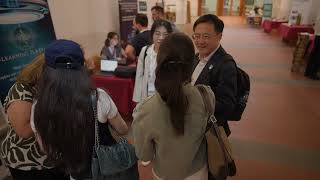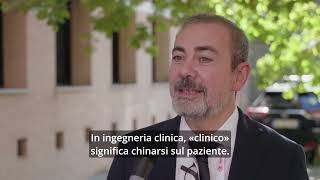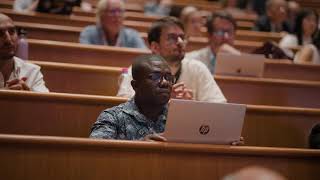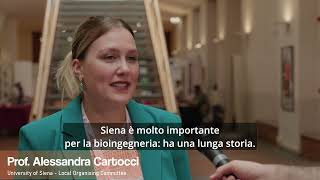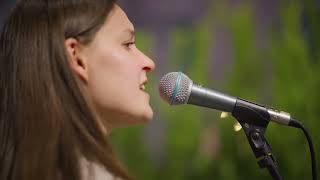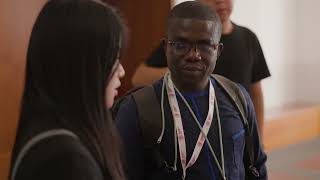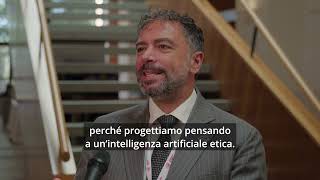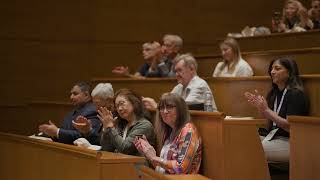
From 14 to 17 September 2026, Siena became the meeting point of the Mediterranean biomedical engineering community. The XVII Mediterranean Conference on Medical and Biological Engineering and Computing – MEDICON 2026 – organised by our Bioengineering Lab under the auspices of IFMBE, brought four days of science, discussion and friendship to the Presidio Mattioli of the University of Siena. We are thrilled with how it went, and deeply grateful to everyone who made it happen.
A truly international community
MEDICON 2026 gathered work from 845 authors from 420 institutions in 54 countries. Over four days, the Aula Magna and the parallel rooms of the Presidio Mattioli hosted keynote lectures, plenary sessions, parallel oral sessions, poster sessions, 8 minisymposia, 17 special sessions and workshops. The accepted papers are now published by Springer in three volumes of the IFMBE Proceedings series, and the Book of Abstracts is also available online.
Four inspiring keynotes
Each keynote looked at the past, present and future of biomedical engineering from a different angle:
- Prof. Sergio Cerutti opened the scientific programme with “50 years of Bridge building between Biomedical Signal Processing and Physiological Modelling and what's the Next”, a journey through half a century of our discipline and a look at where it is heading.
- Prof. Sridevi V. Sarma followed with “Measuring Neural Health: An Energetic Signature of the Living Brain”, on new quantitative ways to assess how the brain is working.
- Prof. Jari Hyttinen presented “Multiscale cardiovascular hybrid digital twins for stratification of hypertrophic cardiomyopathy patients”, showing how digital twins can bring personalised medicine closer to the clinic.
- Prof. Maria Chiara Carrozza, former Italian Minister of Education, closed the keynote series with “Giving Shape to Intelligence: Robotics, Embodiment and the Quest to Understand Natural Intelligence”, on what building robots can teach us about natural intelligence.
The science on the programme
The regular sessions covered the full breadth of medical and biological engineering, including generative AI and machine learning for precision medicine, digital twins and virtual physiological human models, clinical engineering and medical device management, robotics in surgery and rehabilitation, next-generation imaging and diagnostics, bioinformatics, wearable sensors and remote monitoring, smart biomaterials and drug delivery, and biomedical data science and health informatics.
The minisymposia and special sessions, proposed and organised by colleagues from around the world, brought this down to specific challenges. Some of the main threads:
- Artificial intelligence, from the lab to the bedside. AI ran through the whole programme: AI in lung cancer screening, AI and shared decision-making in breast cancer (the CINDERELLA approach), AI applications in clinical engineering, interpretable and generative medical AI, responsible AI in healthcare, and the EAMBES special session on AI in medical devices.
- Clinical engineering and health technology. Sessions on medical equipment ageing and replacement planning, health technology assessment to support decisions in the Italian National Health System, ICT and open data in healthcare, usability and co-creation in medical device design, and 3D printing in medicine, from regulation to clinical outcomes.
- Neuroengineering and physiological signals. Next-generation neural interfaces, motor control and neurorehabilitation; frontiers in neuroimaging; cardiomechanical monitoring; nonlinear methods for medical data analysis; and high-performance computing for molecular modelling in precision medicine.
- Global health and innovation. Medical device development and regulatory pathways in low- and middle-income countries, regulation and standards in Canada, and the IUPESM symposium on flagship projects in medical physics and biomedical engineering.
Shaping the biomedical engineers of tomorrow
Education and the profession were one of the strongest themes of this edition. Several sessions asked what the next generation of biomedical engineers should know and how they should be trained: the minisymposia on harmonising biomedical engineering education in the age of AI and on defining competencies from responsible innovation to curriculum design, the special sessions on future-ready programmes, on essential skills for the future biomedical engineer and on transforming biomedical engineering education in Africa, and the IFMBE session bridging generations in biomedical engineering education. The EAMBES special session on the recognition of biomedical engineers in European hospitals and health institutions put the spotlight on the professional role of our graduates.
Students, challenges and workshops
Young researchers were at the heart of the conference. The IFMBE Students and Recent Graduates session gave space to early-career engineers, and the IFMBE Scientific Challenge asked teams to build methods for the automated classification of facial pigmented lesions from dermoscopic images into seven diagnostic categories. The INBIT workshop on MedTechLabel, a digital labelling framework for medical devices, completed the programme.
Thank you!
A conference is only as good as the people in it. Our heartfelt thanks go to:
- all authors and participants, who brought their research to Siena and filled every session with lively discussion;
- our keynote speakers, for inspiring talks that set the tone for each day;
- reviewers, session chairs and the organisers of minisymposia and special sessions, whose work ensured the quality of the programme;
- IFMBE, EAMBES, AIIC and the Gruppo Nazionale di Bioingegneria, for their support, and Springer for publishing the proceedings;
- the University of Siena and the Comune di Siena, for welcoming the conference;
- our sponsors and partners, who made it all possible;
- and, last but not least, the members of our lab and all the volunteers, who worked tirelessly before, during and after the conference to make every detail run smoothly. We are proud of you!
Hosting MEDICON in Siena was a privilege, and we hope everyone left with new ideas, new collaborations and good memories of our city. See you at the next MEDICON!
Conference website · Proceedings · Book of Abstracts · Full programme